by Dr. Talia Marcheggiani, ND | Feb 9, 2012 | Ayurvedic Medicine, Balance, Cooking, Diet, Digestion, Food, Nutrition
I’m sure all of you can name the 4 taste receptors that scientists have discovered on the tongue: sweet, sour, salty and bitter. However, Ayurvedic medicine has categorized food properties into 6 distinct tastes.
Some of the constitutional doshas require more of certain tastes than others, but it is thought that well-balanced meals encompass all 6 of the Ayurvedic tastes, covering the entire spectrum of food quality. The 6 Ayurvedic tastes are: sweet, sour, salty, bitter, pungent and astringent.
According to Ayurveda, balancing the 6 tastes in the diet aids digestion, ensures physical, emotional and mental well-being and helps decrease aggravation of the dominant dosha of an individual.
About the tastes:
Sweet:We can all easily identify sweet foods, such as honey and fruits. However, sweet taste also includes carbohydrates like rice and other grains, potatoes and milk. Sweet functions include building up tissues and calming nerves.
Sour: Includes acidic fruits such as oranges, lemons and grapefruit, fermented foods (yogurt, kambucha, sauerkraut), alcohol and vinegar. Sour taste acts to cleanse the body and increase the absorption of nutrients.
Salty: Foods that contain salt, from minerals, meat or seaweed. Salt acts to stimulate digestion and improve the taste of food. It also calms nerves and relaxes the mind.
Bitter: Includes dark leafy greens and certain herbs and spices. We often lack enough bitter tasting foods in our Standard American Diet, however, bitter taste is important for detoxification and digestion. According to our Botanical Medicine class, it improves appetite, aids digestion and psychologically “increases one’s appetite for life”.
Pungent: Foods that are spicy, including herbs, peppers and garlic. Pungent tastes increase metabolism and aid digestion.
Astringent: These are foods that produce a “dry” taste in the mouth. Foods that are astringent include legumes, certain fruits, such as apples and pears, certain vegetables, tofu and herbs. Astringent taste helps “dry” fats, thereby aiding weightless, and tightens tissues. In Western Herbalism astringent herbs are used for wound healing and tonifying mucus membranes of the skin, respiratory, urinary and digestive tracts.
Although having a balance of the 6 tastes is beneficial for a healthful diet, increasing certain foods in the diet can help balance the dosha that one is predominant in:
Vata Dosha is balanced by sweet, salty and sour tastes.
Pitta Dosha is balanced by sweet, bitter and astringent tastes.
Kapha Dosha is balanced by bitter, pungent and astringent tastes.
In the Western world we rely heavily on sweet, sour and salty tastes, through a diet high in carbohydrates, processed foods (high salt content) and alcohol (sour). Considering the fact that we live in a Vata-aggravated society, it is comprehensible that our culture gravitates to these tastes more than the other three. However, the leading rise in obesity (Kapha aggravation) could be reflective of the lack of bitter, pungent and astringent tastes in our diets.
In my Ayurvedic course we analyzed various ethnic diets and found that cultures with a set of dietary practices usually include all 6 tastes in their cuisine. We examined Indian, Thai, Persian, Ethiopian and Chinese cuisines, but I also feel that even Italian food represents a balanced diet, according to Ayurveda.
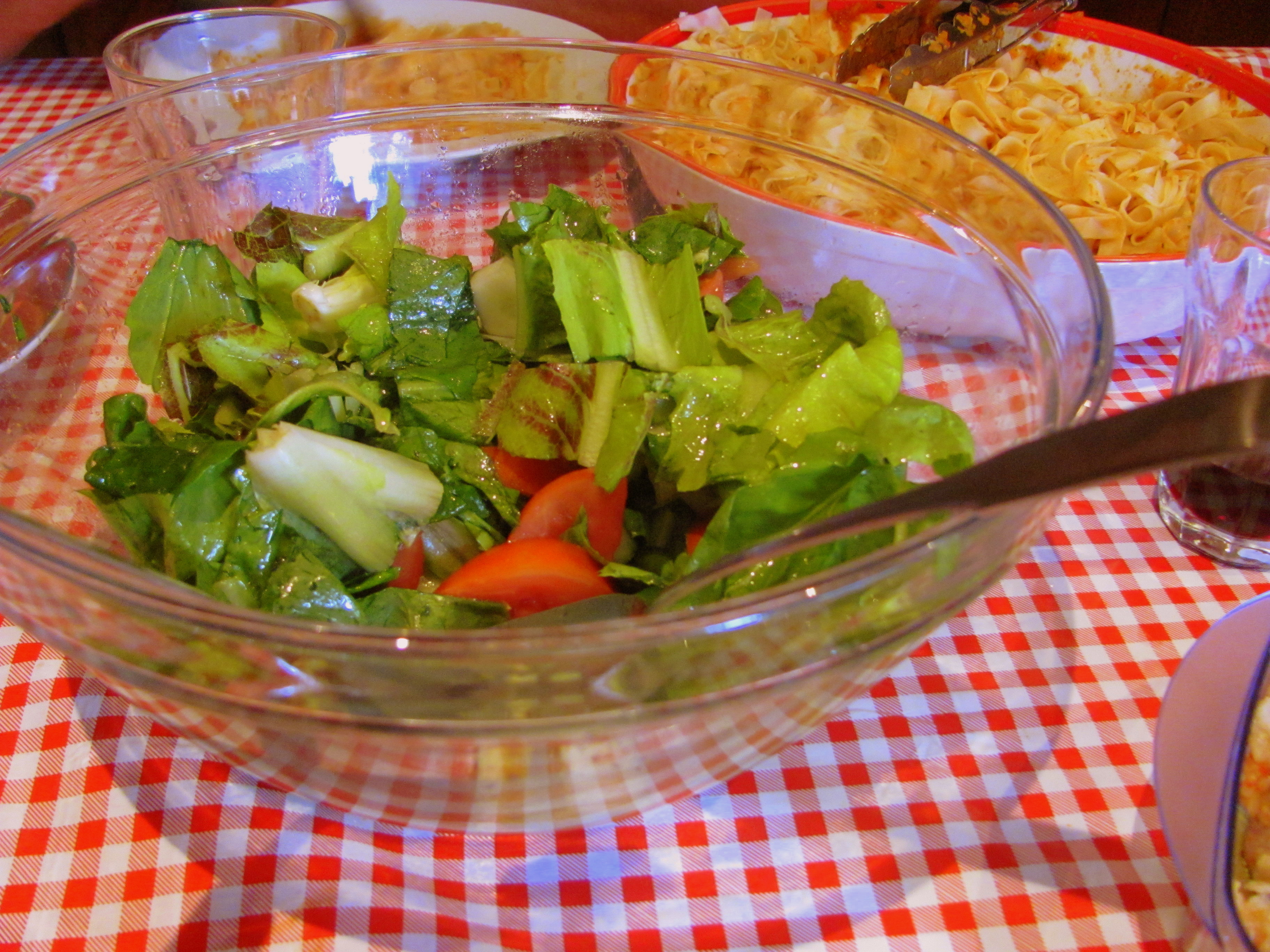
If we take a typical Italian meal – pasta with meat sauce and Insalata Della Nonna– we see that all 6 tastes are represented.

The sweet tastes are represented by the pasta (be it rice pasta, spaghetti squash or another form of pasta), the tomato sauce and some of the vegetables in the salad.
The salty tastes are from the salt and meat added to the sauce.
The sour taste is from the homemade red wine vinegar salad dressing (and the wine!).
The bitter taste comes from the radicchio and fresh garden lettuce in the salad.
The pungent tastes come from the garlic and chili peppers used to make the pasta sauce.
The astringent tastes comes from the fennel and celery in the salad and the apple for dessert.
Dissecting your daily meals for tastes that your diet may be missing is a fun and therapeutic practice. Use it to see how your own diet (whether it is one you have invented for yourself or the one dictated to you by your family or country of origin) may be improved by adding certain flavours. I find it aids me in achieving balance in my own diet, especially when traveling to a new country or designing my own meals. Practicing mindful eating is helpful to detect and distinguish the flavours of your favourite food staples. Chew them slowly and try to decide if the food in your mouth is sweet, salty, sour, bitter, pungent or astringent, or a combination of two or more of these flavours.

by Dr. Talia Marcheggiani, ND | Feb 8, 2012 | Cooking, Dessert, Diet, Digestion, Gluten Free, Nutrition, Recipes
 After reading and, therefore, being terrified by the book “Wheat Belly” by William Davis, MD, I decided to continue with my attempt to jump on the gluten-free bandwagon (or just run alongside it from time to time).
(more…)
by Dr. Talia Marcheggiani, ND | Feb 7, 2012 | Asian Medicine, Meditation, Self-care, Sleep, Stress, Yoga
Cortisol, the stress hormone, is released as part of a the Fight or Flight response. You’ve probably heard the story: back when we were huntering and gathering, when faced with a wild, sabor-toothed tiger, adrenaline was released, our blood vessels dilated, our hearts beat faster, our breath became rapid, blood was directed from our digestive organs to our muscles and we prepared ourselves to either confront the hairy beast or head for the hills (or up a tree)!
Now, instead of sabor-toothed tigers, we have exams, deadlines, tension-filled family dinners, presentations to give and blog articles to write. Instead of experiencing the Stress Response for a fleeting moment, we experience it continuously throughout our professional lives.
During a normal, healthy day, cortisol is high in the morning, when we wake up. This enables us to feel awake and leap out of bed with the bright-faced vigor of the hated “morning person”. It enables us to start our daily activities. Cortisol should level off throughout the day and then peter off right before bed time, as we digest our dinners, cuddle with loved ones before the fire and prepare to settle down for a nice, long sleep.
Unfortunately, that’s the picture of a balanced individual living in a stress-free world. In today’s world, because we are continuously living in sabor-toothed tiger-mode, our normal cortisol cycle is out of whack. Cortisol is sluggish in the morning when we haul ourselves out of bed (after hitting the snooze as many times as you can remember) and groggily start our day (with the help of the beloved espresso machine). In the afternoon we crash; we feel tired and useless all day long. Then, right before bed (I’m sure many of you have experienced this), we feel an energy we never thought possible. At 11pm we experience a cortisol high, characterized by a flurry of mental and physical activity, and find it impossible to fall asleep. It is common to hear people who suffer from chronic fatigue lament: “I wish I was as energetic throughout the day as I am at bedtime!” Of course, the harder it is for us to get to sleep, the less we sleep and the worse we feel in the morning, worsening the cycle.
Here are some tips to attempt to break the cycle and prepare the body for bedtime:
1) Eliminate non-sleep activity in the bedroom. Reserve your bed and, preferably bedroom, for sleep and sex. Studying and doing work on your bed confuses the psyche. Only entering the bed when it’s time for sleep, signals to the brain that it’s time to rest.
2) Keep the bedroom dark. Even a minimal amount of light can lower melatonin levels, an important sleep hormone, and make it harder to fall asleep.
3) Limit the exposure to electronics (laptops, television, smart-phones, etc.) 1-2 hours before bedtime. Not only does the light from these devices interfere with melatonin secretion, they also contribute to the secretion of cortisol by stimulating mental activity and, if the activity is work-related, generating stressful thought.
4) Begin a pre-sleep routine. It can be a simple meditation or a series of calming yoga poses (try “legs up the wall pose”, pictured below). You may simply choose to sit quietly in the dark. When I have trouble falling asleep I access an audio podcast meditation on meditationoasis.com. This helps me turn off the Fight or Flight response by calming my mind.
5) Consider magnesium supplementation. Magnesium is a natural muscle relaxant. Taking a dose before bedtime helps reduce the muscle tension we have built-up over the course of our stressful day and helps relax the body and prepare for restful sleep. Talk to your naturopathic doctor about correct dosing and to find out whether supplementing with magnesium is suitable for you.
6) Sleep like Buddha. According to Ayurvedic medicine, as taught in my continuing education course with Matthew Remski, the right side of the body is the Solar Side, and the left side the Lunar side. Before bed the left nostril should be more open than the right, indicating that our left, or lunar, side is more active. Try lying on your right side and, with your right pinky, block your right nostril. Breath through the left nostril for 15 minutes. You may find that your left nostril feels “stuffy” at first. This tells you that your lunar side has not yet been activated. Continue breathing only through the left nostril and you will find that, after a small amount of time, it begins to unblock and becomes the more active nostril. In the East, all statues of sleeping Buddha show him lying on his right side with his right hand under his head, as he shuts down his solar side and prepares for sleep.
In the morning you may want to try blocking the left nostril and breathing only through the right in order to activate your solar side as you begin the day.
*This article is not meant to diagnose or treat. Please visit a trained naturopathic doctor for an individual consultation and treatment plan tailored to your individual needs.
by Dr. Talia Marcheggiani, ND | Feb 4, 2012 | Uncategorized
This common time, Monday, February 6 from 12:15-2:00 pm at the Canadian College of Naturopathic Medicine, an OAND Town Hall meeting will be held regarding the Transition Council, to discuss the new legislation for naturopathic doctors in the province of Ontario.
As future NDs it is our duty to make sure our interests are taken into account. Show up to help us defend our rights and scope of practice! We must take part in this legislative process as the future of our profession depends on it.
So, please come out and show your support, and make sure your voice is heard. We can’t let the interests of a select few dictate the future of our careers and the legacy of our profession.
We all know how much time and money we’ve sacrificed to ensure that we have the proper education to become primary care providers! We want to be recognized as such! We have the tools to help so many people, we should be allowed to use them! El pueblo, unido! So show up this Monday and let’s OCCUPY CCNM!

by Dr. Talia Marcheggiani, ND | Feb 3, 2012 | Cooking, Digestion, Food, Nutrition, Recipes, Salad
 When people picture “healthy food”, chances are high that the first food that comes to mind is salad, especially nutrient-rich spinach salad. According to Traditional Chinese Medicine, raw foods require more digestive “heat” to break down and, therefore, are not recommended in the winter, unless accompanied by warming spices, or soups and stews.
(more…)
by Dr. Talia Marcheggiani, ND | Feb 2, 2012 | Asian Medicine, Ayurvedic Medicine, Digestion, Food
According to Ayurveda, disease is a result of poor digestion and poor assimilation of food into the body. Therefore, when we take care to attend to our digestive health, we prevent the occurrence of disease.
Here are some tips from an excellent book a classmate lent me; The Path of Practice: A Woman’s Book of Ayurvedic Healing by Bri. Maya Tiwari, taken from page 355. These suggestions also happen to coincide with a talk that Erica gave to a group of colleagues at the Canadian College of Naturopathic Medicine and so I have to give her credit as well!
1) Meal Sizing:
The largest meal of the day should be lunch. This is a very European method of eating and I practiced this tip while living in Colombia. It helped me feel balanced and nourished throughout the day. It also ensured I had a restful sleep in which I didn’t need to digest a large dinner. The size of the largest meal, according to Ayurvedic practice, should be the size of two anjali, two hands cupped together, or two cups (500 ml) of food. This is the maximum volume of food that the average human stomach can hold at a time.
The size of the other meals should be one anjali (one cup) or less. If you are a mentally and physically active person and eating this way over time results in hunger, then it is suggested that you increase the amount of meals in your day, limiting each one to the size of one anjali.
2) Food combining:
Fruits are best eaten alone, one hour before or after a meal. Fruit tends to ferment in the digestive tract and can interact with the digestion of other foods. Eating fruit and dairy products together should also be avoided (e.g.: fruit and yogurt or ice cream) because the acidity of the fruit can rot the milk in the stomach, leading to poor digestion and assimilation.
Avoid combining sweet and sour foods in the same meal. The two tastes counteract one another and irritate the digestive tract, which interferes with proper digestion. Also avoid complex combinations of food, which include dairy (basically every Standard American Diet food staple): tacos, lasagna, meat lover’s pizza, poutine, chili cheese fries and so on.
3) Preparing meals:
A nice tip from Matthew Remski, teacher of my “Everyday Nectar” Continuing Education Ayurvedic class (at the Canadian College of Naturopathic Medicine) is that you should limit meals to no more than three different foods at a time. Making more complicated meals also complicates digestion. A great rule of thumb, especially as we move into Fall, is to try to cook all of your food in the same pot; think stews, soups, curries and rice dishes. This allows your stove to partially “digest” the food for you, making it easier on your body, which should conserve all the energy it can during this stressful season.
4) Stoking the digestive fires:
Drink 1/2 a cup (125 ml) of warm water before eating each meal. This helps to activate agni, the digestive fire that helps “burn” food and increase it’s absorption. Avoid drinking during or after a meal, especially cold water. This can affect the digestive fire in the stomach, prevent proper food breakdown and even lead to weight gain.
5) Eating mindfully:
Practice eating mindfully and chewing eat bite of food thoroughly. In naturopathic medicine it is common to hear people say “drink your food and chew your water”, meaning that food is chewed into a liquid before being swallowed. My family and I eat like wolves and this practice is extremely difficult for me to adhere to. However, I find that, when I try to chew properly, I experience less abdominal bloating after meals. I also feel more satisfied after eating and experience less food cravings. According to ayurveda, proper chewing ensures thorough digestion and assimilation, which also satisfies emotional cravings for food. This is especially helpful for people who crave unhealthy foods or who tend to binge eat.
Lastly, Bri. Maya Tiwari tells us to “practice eating our meals in a spirit of harmony and gratitude.” When we engage in serious, stressful conversation at the dinner table or eat on the run we are essentially wasting our body’s digestive juices and preventing their secretion. Digestion is a very difficult, energy-consuming task for the body. It is essential that we acknowledge the effort our body is making to break down our food and absorb the nutrients. Food should be eaten slowly and mindfully, sitting down, and preferably in silence. In many cultures grace is given before a meal. It may help you to silently say your own grace, giving thanks for the opportunity to eat the food before you and to your body for the ability to digest and assimilate the nutritious food that you have prepared for it.
I’ll admit that these tips are not easy to incorporate into one’s busy lifestyle, especially if you love to inhale your food (like me) or if you tend to rush through meals on auto-pilot. At first, these tips can be daunting, however, giving each one thoughtful consideration and taking the time to mindfully assimilate each one into your daily routine can have profound effects on your health, preventing gut irritation, bloating, food cravings and weight gain.
This article was also featured on active.com, and received by many dissenting commenters! Feel free to check it out and become part of the debate.
*This article is not meant to diagnose or treat any disease. Please visit a naturopathic doctor or ayurvedic specialist for a complete assessment and treatment plan.
by Dr. Talia Marcheggiani, ND | Feb 1, 2012 | Balance, Diet, Exercise, Food, Meditation, Mental Health, Mindfulness, Music, Nutrition, Sleep, Technology
We’ve all heard of the potential health implications of spending too much time wired in. Whether it’s the radiation from our cell phones, the arthritis that sets in our thumbs, the damage done to our interpersonal communication skills or the strain on our eyes, we’re constantly told about the negative health implications of our technological age.
However, as much as we hear these warnings, there is no chance that our electronic lifestyle is going anywhere soon. Wireless technology, the internet and smart phones are here to stay. They serve as essential tools for the rapid-paced society we live in. While I advocate taking an “electronic-free” day off each week to give your nervous system a break, I wonder if all this technology can actually have a positive impact on our health. Here are my favourite apps for Android and iPhone that can promote your health rather than hinder it.
1) Pocket Yoga: Of all the Android yoga apps out there, this one is by far my favourite. It’s
not free (it costs $3) but it actually takes you through a series of yoga workouts rather than just showing you a list of poses. The app gives you the option of choosing from three different settings (mountain, ocean or desert), three different workout lengths (30 minutes, 45 minutes or 1 hour) and three levels of difficulty (beginner, intermediate, advanced). When staying at my aunt’s cottage I roll my yoga mat out on the grass, put my phone beside me and get into the flow.
2) Sleep as Android (or Sleep Tracker for iPhone): The idea behind the mechanism of this app is that, when we sleep lightly we move around more than when we enter states of very deep sleep. With this app, you set your alarm and put your phone on your mattress while you sleep and the sleep tracker senses your movement throughout the night. Rather than being jarred out of a deep and comfortable sleep, your phone waits for you to enter a state of lighter sleep, up to half an hour before your desired wake up time, before sounding the alarm. Using this app has helped me greet the day with a less groggy disposition and makes me feel like I’ve slept more soundly. The sleep tracker also produces a graph when you wake up, giving you information about the quality of sleep you experience each night. Take advantage of the 14-day free trial and see how this app makes a difference in how you begin your mornings.
3) Meditation Oasis: These apps may cost $1 each, but are very relaxing, guided audio meditations. I listen to these audio meditations to help relax both my body and mind (especially after a stressful day) before going to sleep. They’re also very useful guides for those who want to start a daily meditation practice but aren’t sure how to begin or even for those who just need a mental break from study or work. If the internet is available, you can go online to the listening page at meditationoasis.com and choose from a free list of 43 different guided meditation podcasts for varying levels of expertise.
4) 8tracks: Whether you need a fast-paced playlist to accompany your daily workouts or some calming music to help you relax, 8tracks will have an awesome compilation of songs for your musical taste. We live in a visual culture and sometimes it’s therapeutic to turn off the visual stimulation, steep a cup of tea and listen to some soothing, stress-relieving music. You can download this free app onto your phone and browse through a variety of music playlists according to genre.
5) My Fitness Pal: This free app is a portable tool that can be used anytime for tracking your daily nutrition. You simply use the database to search for and enter in the foods that you eat each day. This app helps you track weight loss goals by giving you a personalized caloric intake target based on your age, weight, gender and activity levels. It’s also very useful for people with other diet goals, such as limiting sugar, increasing dietary fibre intake or consuming an adequate dietary intake of micro-nutrients (vitamins and minerals). By using this app you’ll have a more accurate view of your daily nutrient intake and will be motivated to make healthier food choices.
by Dr. Talia Marcheggiani, ND | Jan 31, 2012 | Uncategorized
by Dr. Talia Marcheggiani, ND | Jan 31, 2012 | Asian Medicine, Ayurvedic Medicine, Family, Homeopathy, Law of attraction, Love, Spirituality
We’ve all heard the Golden Rule before: “Do unto others as you would have them do unto you”, and its many variations. But, how valid is this rule and it’s impact on leading a happy, healthy and morally sound life? I look at lessons in homeopathy and ayurvedic philosophy for insight.
Ayurvedic philosophy states that the reason for abstaining from morally unsound deeds (lying, stealing, killing, etc.) is because, once one begins to engage in these acts, one begins to create a world in which these acts become feasible. In essence, the ayurvedic philosophers claim that we create our own reality: once we begin to steal and lie, we create a reality in which stealing and lying becomes possible and we run the risk of other people beginning to steal and lie to us.
This concept of creating your own reality is inherent in homeopathic theory as well. In homeopathy, in order to understand the case that a patient presents with we must examine every minute detail about the patient. If someone expresses a frustration about something or someone that appears distinct from themself (“people are liars” or “you can’t trust anyone”) they are really expressing a statement about themselves. Our professor Dr. Nadia Bakir tells us that in order to recognize something about our environment we are really recognizing it from a point deep within ourself. If we didn’t already embody this characteristic then we wouldn’t be able to observe it in others – it wouldn’t be a part of our reality. In some ways it makes sense, those who embody the characteristic of cynicism tend to see the negative side of life, ignoring the positive and even managing to manifest negative outcomes in their own life situations.
This means that, in order to live in a world where people are honest, thoughtful and generally concerned about others we must first work to cultivate those characteristics in ourselves. As Gandhi says “Be the change you wish to see in the world”.
It must be said that these concepts can be dangerous if we take them a step further and claim that people who are the victims of unfortunate accidents or deadly diseases “brought it on themselves”. However, there is some evidence that suggests people who think positively about their cancer diagnoses, for example, experience greater quality of life and a better prognosis.
This philosophy is not meant to undermine those who have experienced loss or are going through a difficult time. It only serves as an inspiration for those who wish to cultivate a better world and take some responsibility for their outlook on life. It’s important to understand that we don’t each live in our glass bubble. Our personal views manifest as actions and our actions affect other people, which in turn affect how those people react to us. So, in a sense there is some truth to “doing unto others as you would have them do unto you.”
by Dr. Talia Marcheggiani, ND | Jan 29, 2012 | Cooking, Diet, Digestion, Food, Stress, Student
There are few things as comforting as being greeted by a steaming bowl of warm oatmeal on a cold winter morning. Unfortunately, who has the time to prepare a pot at 6:30 in the morning? Isn’t it a shame that we can’t all have our own personal chef who prepares a warm, nurturing and filling breakfast for us everyday?
Actually, there is a way that you can have your own personal chef that works while you sleep: dust off your slow cooker!
Slow Cooked Steel Cut Oatmeal with Apples, Cinnamon and Nutmeg
Steel cut oats are a minimally processed form of oat that usually takes 15-30 minutes to prepare (by simmering in a pot of water). They have a chewy texture and are low on the glycemic index (therefore a better option for those who are diabetic or pre-diabetic). They are slowly digested, gradually releasing sugar into the bloodstream, which helps keep you feeling satisfied for longer into the morning. Oats are a good source of fibre, which has been linked to a decrease in the incidence of heart disease, stroke, diabetes and certain cancers. Steel cut oats also contain soluble fibre, which has been shown to lower cholesterol levels.
Adding apple, cinnamon, nutmeg and ginger to steel cut oatmeal not only adds more fibre, a serving of fruit, but also adds a serving of healthy spices that regulate blood sugar (cinnamon), aid digestion (nutmeg) and warm the body on a cold morning (ginger).
Here’s how to make steel cut oatmeal in a slow cooker:
In the evening add to your slow cooker:
– 1 cup steel cut oats
– 4 cups of water
– 4-6 apples of your choice, cut into small pieces
– 1 tbsp of cinnamon (or more)
– 1/2 tbsp of nutmeg
– 1 piece of sliced ginger
Set slow cooker to LOW and allow to cook overnight (approximately 8 hours). In the morning, turn it off and serve oatmeal hot. Serves 4 people.
I often make enough Slow Oats to feed me for the week. I refrigerate the leftovers and microwave my portion in the morning.
Here’s to easy, delicious winter mornings where you can enjoy a hot morning meal while watching the snowfall and waiting for the rest of the world to wake up.