Are some physical ailments “all in our heads?” The mind is a powerful organ, capable of creating reality for us. In the world of health, the mind can be a powerful healing tool, or a powerful hindrance to true cure.
As a Buddhist tenet suggests, all suffering is present in the mind: pain, itching and discomfort especially. The mind, when stressed, has the ability to produce a number of physical symptoms, pain being one of them, but also skin ailments, digestive concerns, weight gain, hypertension and virtually any other complaint take up significant residence in the mind. Is your eczema expressing an anger that you’ve been holding in? Is your inability to lose weight a need to shield yourself from the world? Our homeopathy professor holds that the our symptoms are outer expressions of an inner, emotional state and, in controlling our minds and dealing with repressed emotions, we can resolve the physical as well.
In 1955, the doctor Henry K. Beecher named this tendency of the mind the “Placebo Effect.” According to Beecher, 35% of patients got better when given a sugar pill, indicating that, when the mind believed it was being treated, it spontaneously resolved symptoms based solely on its own expectations. This effect was so pronounced that, to this day, clinical trials are all but tossed out if they are not controlled for the placebo effect by giving one group a sugar pill.
It’s unfortunate that in modern healthcare this healing power of the mind is dismissed as “placebo” and not exploited further. After all, harnessing the power of the mind is cost-effective and side effect-free. There are many ways to enhance the Placebo, or as some of my supervisors like to term it, the “Meaning Response,” such as good patient rapport, a healing intention and therapeutic setting. However, when we talk about placebo, we’re really just talking about tapping into the mind-body connection, harnessing the mind’s powerful ability to influence the physical body. Giving patients a sugar pill is only one part of it.
Seeing patients at the Robert Schad Naturopathic Clinic made it clear to me how much of an obstacle to cure mindset can be. Often times patients’ core beliefs prevent them from getting better, especially if mental and emotional issues are at the root of their physical concerns. In many cases there is an ingrained belief of benefit to being unwell, or an unconscious fear of getting better. I find that identifying this fear helps untangle some of the mental obstacles to cure and helps patients approach healing with a renewed enlightenment.
Tapping into these unconscious beliefs is difficult, however. If approached from the wrong angle, the topic can seem insulting or belittling from the patients’ perspective. There are books such as “Messages from the Body” or Louise Hay’s “Heal Your Life”, that attribute emotional afflictions to physical ones in a dictionary-like layout, however the emotions behind a complaint are individualized and therefore such mind-body exercises are best explored on an individual level.
In the book Fat is a Feminist Issue, a comprehensive self-help book for compulsive eating and negative body image, there is a useful visualization that helps individuals access the feelings and beliefs that are preventing them from getting well. This book focusses on disordered eating and weight loss, however I’ve used the same visualization for a variety of complaints, including depression, circulatory problems, chronic infections and skin issues. The visualization consists of asking the individual to observe themselves as they are and then imagine that their condition is getting worse, then better. The visual dramatization often allows the individual to access the deep-held feelings, both positive and negative, that accompany both the worsening of and the alleviation of their complaint.
To truly access the deeper-held feelings, this meditation should be performed repeatedly. Those who attempt the visualization commonly realize:
1) There are positive aspects to having the condition: the condition protects them in some way, the condition benefits them in some way.
2) There are negative aspects to recovering: There is something threatening about the person they could become or the life they could lead without being burdened by the condition. There is something frightening about moving forward.
For stubborn conditions that do not respond to treatment, or conditions that commonly relapse, it becomes clear that, unless the mental-emotional reasons for having the condition or avoiding remission are addressed, cure is impossible.
This visualization is best done lying down and relaxed. It can be done with a trusted healthcare practitioner or alone as a meditation exercise. The party scene can be substituted for another scene that may be more relevant for you and words pertaining to your specific condition can be substituted as well. The dots (…) indicate a pause in the narrative.
“Fat/Thin Fantasy” from Fat is a Feminist Issue by Susie Orbach
I’d like you to close your eyes, get as comfortable as you can, follow your breathing, in and out, in and out, and relax…
I’d like you to imagine that you are at a party…. This can be either a real party or an imaginary one… It might be a dancing party, a talking party, a small intimate party… Set the scene and take notice of your thoughts…. feelings… and body sensations… What are you wearing?… How do you feel in those clothes?…. What is your posture like?… Try and feel yourself in your body…. Now notice your behaviour at this party…. Are you an observer?… Are you actively mixing with other people?…. do you feel withdrawn?….
As you observe yourself at this party, I’d like you to imagine that (your condition is worsening)… How do you feel?… Try to be aware of your feelings…. and thoughts….observe any negative feelings about (having your condition worsened)… observe any positive feelings about (feeling this way)… what are you wearing?…. How is your body positioned?…. What is going on at the party and how are you interacting with the other people there?…. Now, imagine that (your condition) is communicating with the people at the party…. What is it saying to others?… is there a way in which it helps you to (have this condition) in this situation?… Does (having the condition) allow you to do or say certain things or act in particular ways?…
Now imagine that (your condition) is slowly vanishing, fading away and, in this visualization, you are completely healthy…. can you see yourself?…. can you feel your body (without the condition)?… notice what you are wearing…. what do your clothes say about you?… notice your body position…. you posture…. what do you see from the perspective of being completely healthy?… do you view the party, other people, with different eyes?… how do the people at the party view you?…. How do you feel?…. pay attention to any feelings that arise… positive feelings…. and negative feelings… are you sure of yourself?…. do you feel vulnerable?… are you you?…How are you getting on with the others at the party?… Are there differences in the way that you interact with others?…. Is there anything scary of unpleasant about (having this condition)?…
Now I’d like to you to imagine that you are back to the body you have now…. does the atmosphere change?… can you contact any feelings of relief about being back in your present body?… Allow yourself time to experience whatever feelings are coming up… notice your responses to other people… how you feel about yourself… watch these feelings without judgement, as an observer….
Now, look back over this entire visualization exercise…. see what new information came up for you about yourself… When you are ready, come back into the room and open your eyes…
Reference:
Orbach, Susie (1978). Fat is a Feminist Issue. Galahad Books: New York, NY.
I recently came across this Ted Talk, by Shawn Anchor, recommended by a fellow student. The insightful, well-delivered, entertaining talk is important in the field of naturopathic medicine because it stresses the importance of positivity for living a life of health and happiness.
Shawn expresses the idea that only 10% of our inner happiness is due to external factors: our job, possessions, education, etc, while the other 90% is attributed to how we perceive those circumstances. We live in a society where we focus on reaching goals, thinking that once we reach those goals we will be happier: “When I lose 20 pounds, I’ll feel happy with myself,” “When I get that raise, I’ll like my job,” or “If I get into that school, then I’ll feel great.” It reminded me of a story our Mindfulness Based Stress Reduction teacher told us on Tuesday night:
Therewas once a fisherman, sleeping in his boat. He had caught all his fish for the day and so he was enjoying the sunny afternoon by taking a well-deserved nap, when along came a businessman.
“What are you doing?” Asked the businessman.
“I’m resting.” Replied the fisherman, “I’ve caught all my fish for the day.”
“Why don’t you go out and catch more?” Asked the businessman.
“Why would I do that?” Wondered the fisherman.
“Well, if you went out and caught more fish, you’d make more money.” Stated the businessman, as if it were the most obvious thing in the world.
“What would I do with more money?” Inquired the fisherman.
“You could buy a bigger boat.”
“And what would I do with a bigger boat?”
“Well,” replied the businessman, “You could catch even more fish, then. Then you could make even more money, buy a fleet of boats, employ other fishermen, catch even more fish and make even more money.” He finished, seeming pleased with his insightful advice.
“And what would I do then?” Asked the fisherman, who by now was very confused.
“Well,” exhaled the businessman, on a role now, “then you could really enjoy life!”
The fisherman looked at his beautiful surroundings, the afternoon sun dancing on the calm waters of the harbour; his humble but comfortable boat serving as the perfect place to rest. He looked back up at the businessman, who by now was looking quite triumphant, and replied,
“And what the heck do you think I’m already doing?”
Like the fisherman, being content with your life’s present circumstances is the key to increased enjoyment and satisfaction. According to Shawn Anchor, becoming more positive isn’t hard: he proposes a way to increase your satisfaction and overall happiness by spending only 2 minutes a day for 21 days in a row.
He suggests a list of activities that one might engage in, including exercise, meditation or journalling. One of the activities that stood out for me is expressing daily gratitude by taking 2 minutes at the end of each day to journal 3 things you have been thankful for in the past 24 hours. According to Shawn, this simple task is enough to set the brain on a different path, one that leads to increased happiness.
I often find that, in my life, I spend my time focusing on my goals and aspirations for the future. While this striving for future goals is what I’ve been taught to do in order to experience successes in my life, it results in my inability to pay attention to and enjoy my life in the present. Changing my lens of focus to the life blessings I have now allows me to marinate in the present. I find that, while it may takes some time to shift my gaze to the things I already have, rather than the things I’d like to have, once I got started, it was hard to stop at just listing three things. I felt like I wasn’t doing my life justice by excluding the numerous gifts I’m given on a daily basis.
I also like the idea of putting these pieces of gratitude on small pieces of paper and storing them in a glass jar in a visible place. At the end of the month, or during a bad day, I open my jar and pull out a few pieces of gratitude, reminding myself how charmed my life actually is, and thus rewiring my brain to truly appreciate and enjoy it.
I am currently reading the book Full Catastrophe Living by Jon Kabat-Zinn, the founder of Mindfulness Based Stress Reduction, MBSR, a mindful meditation program that I am currently taking, and I came across this paragraph that I thought was worth sharing with all of you:
“You probably won’t be surprised to learn that the word health itself means ‘whole’. Whole implies integration, an interconnectedness of all parts of a system or organism, a completeness. The nature of wholeness is that it is always present.
One of the reasons I chose to do my undergrad at Queen’s University (in Kingston, Ontario) was the beauty of its campus. The ivy-covered limestone buildings filled with me a romantic vision of what a student’s life should be. I imaged myself strolling to class among these majestic white castles or languidly reclining on the deep green lawns, ivy covered limestone surrounding me, as I perused my latest textbook.
What does space mean to you? Is it a necessity? A status symbol? A burden?
A friend and I recently went to see a documentary at the Toronto Hot Docs festival called Tiny: A Story About Living Small. The doc follows a young couple who embark on the project of building their own tiny house, measuring roughly 100 square metres, in order to secure their footing in an increasingly growing movement of downsizing living spaces in favour of simplicity.
With the growing rates of obesity in our society, combined with the tendency for most people who successfully lose weight to gain it back only a short while later, it’s obvious that something is flawed in our society’s general weight-loss strategy.
I’ve been reading a book I recommend to all of you: The Consolations of Philosophy by Alain de Botton. This book is, in one, a Western philosophy refresher course and self-help book, outlining a guide for living as dictated to us by 6 great philosophers. One of my favourite chapters examines the life and philosophy of Greek philosopher Epicurus and distills the lessons he shared with us about finding true happiness and fulfillment in our lives, while still living modestly.
I realized it one day, while spending a particularly delicious Saturday in one of the armchairs of the living room, feeling the sun warm my back as it streamed through the shutters: for the first time in a while, I didn’t feel stressed. Coco was draped across my back, lying on the back of the chair. As if on cue, he let out a long puff of a sigh, his eyes closed. Coco is never stressed, I thought to myself. And then I realized it: Coco is more naturopathic than any doctor could hope to be. As Dr. Stargrove said, at The Gathering in Chicago, “nature knows more than doctors ever will.” And Coco, with is furry body and leathery paws is much closer to nature than any of us will ever be.
I eat fast. I love taking huge mouthfuls of food and I’m usually the first one finished at the table. Maybe it’s because I’m Italian and have spent years becoming comfortable stuffing my mouth with large, heaping forkfuls, roped in spaghetti.
My art is mainly inspired by nature or by places I’ve traveled to or read about. It doesn’t tend to emphasize detail and, when humans are included in the composition, they are usually faceless, depicted as chunky, cubist blocks of colour. People are rarely the main subject of my paintings. And, unlike Frida Kahlo, one of my painting idols, I have never entered the world of portrait painting, much less self-portrait painting.
When painting the facial features of other people, one must pay obsessive attention to detail. This is a skill I don’t have when it comes to painting. It’s almost as if, through painting, I can leave the burden of fussing over details behind to pursue a sense of therapeutic self-pleasing aesthetic that focuses on colour and shape, rather than the fine lines and subtleties. I tend to spend far too much time obsessing over details in real life and so I view painting as an escape from that. When painting life-like portraits, however, such an escape is impossible.
But, like Picasso, I want to become an artist-of-all-trades or, at the very least, claim experience with different subject matter. So, besides feeling that the experience would be tedious and slightly narcissistic, I decided to attempt a self-portrait.
The thing about self-portraits is that we know our own faces very well. From my teenage years through young adulthood I remember countless hours spent obsessing over my reflection: squeezing zits, plucking eyebrows, willing my nose to shrink and wondering what made my face less poetic than that of a famous actress or singer, almost like there was a secret beauty ingredient I might have been born lacking. Painting a self-portrait demands an attention to detail unlike any other mirror flirtation ever performed. From the exact shape of the mouth, to the way the cheeks are outlined, I found myself staring at parts of my reflection that I had never experienced before.
Because I’m not experienced in portrait-painting, the painting started out rough. My oil-painted face was taking on a deformed, misshapen quality, it didn’t look like me, and I found myself criticizing the painting, judging it, and then my own abilities. I then realized, painfully, that this was akin to the way I would criticize my real-life reflection. After a while, though, I found myself comforted by my outline’s familiarity and that comfort turned into a sort of visual satisfaction. This was my face: the window to the person I am who lies beneath and the signature that accompanies everything I say or do in this life. I began to make peace.
Creating art allows us lots of space for reflection. Perhaps that’s why it’s so therapeutic. As I mix colours and apply paint to canvas my mind relaxes and wanders, uninhibited, into new terrain. I find that while painting it helps to have a notebook handy because one artistic pursuit nurtures another and I find myself inspired to not only paint, but write as well. On this portrait-painting day in particular, I felt a relaxing space open up for reflection on who I am now, at 26 years of age. My reflection may have changed some, but behind the wide gaze, I could still see the smirk of that 9-year old, in the Universal Studios sweatshirt, who was imaginative, idealistic and shit-disturbing, all at once. I wonder if this 9-year-old knew that in a few years’ time she would be studying something called naturopathic medicine.
This summer has been dedicated to reviewing basic medical sciences for NPLEX and working as an English as a Second Language (ESL) teacher in Toronto. I haven’t made much time for long contemplative walks, reading literature, laying on the grass, socializing or, most of all, painting or drawing. The way I structure my day is a reflection of my disbalance, not my actual interests and priorities and, as I paint, my evolving painted self stares back at me from it’s canvas home and asks me, “is this what you wanted?”
I’m not sure. But portrait painting shows me that there is a link between borderline narcissism and self-contemplation. Maybe that’s why it’s called self-reflection.
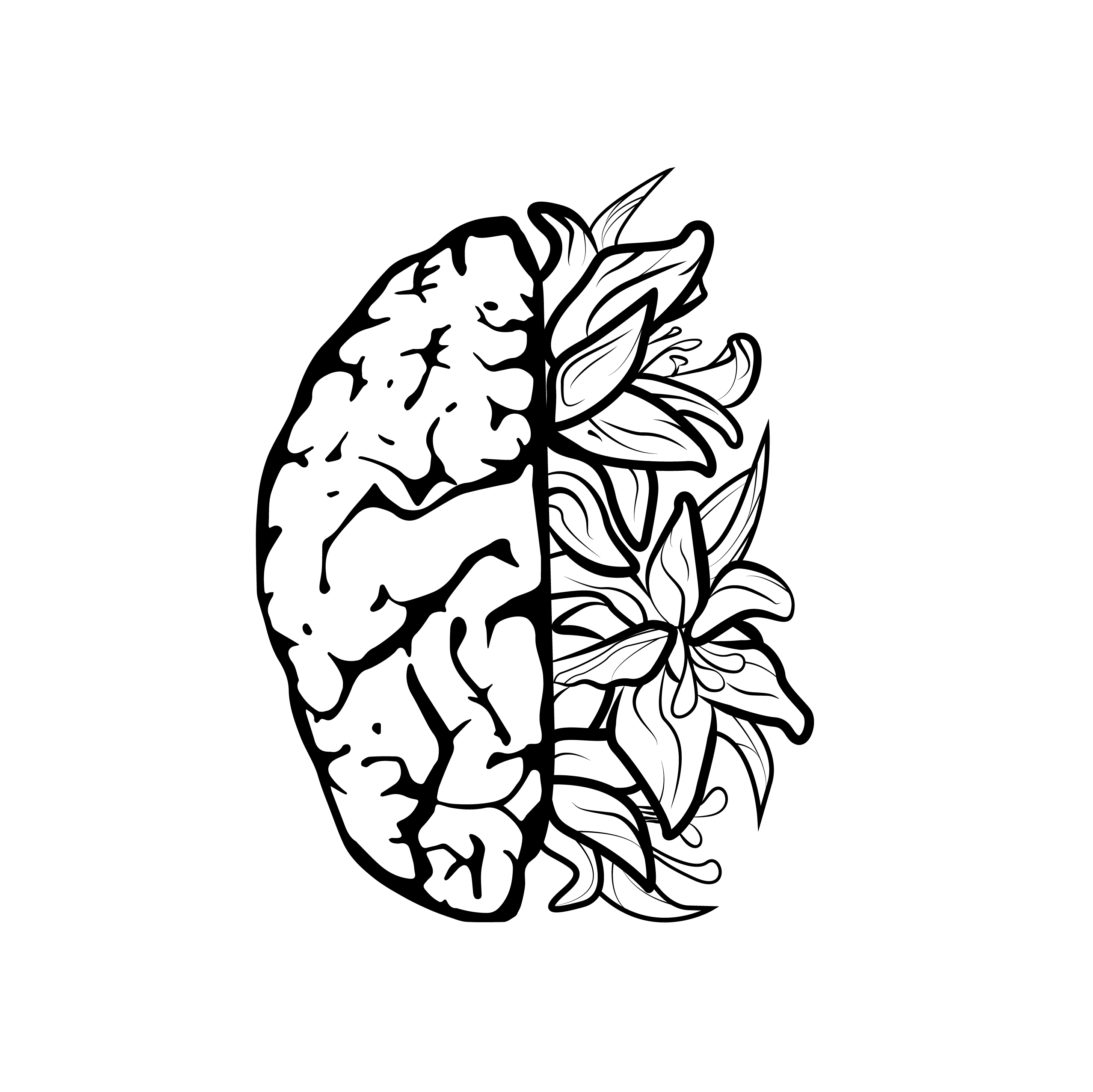

 Are some physical ailments “all in our heads?” The mind is a powerful organ, capable of creating reality for us. In the world of health, the mind can be a powerful healing tool, or a powerful hindrance to true cure.